Study MBA in Japan for Nepali Students: Complete Guide (2026)
If you plan to study MBA in Japan, it will cost you between NPR 20 lakhs to NPR 50 lakhs annually, which includes your tuition fee and expenses as well. You require a bachelor’s degree, 2 years of professional experience (in most cases), and proficiency in either the English or Japanese language. Some of the top institutions for an MBA program include Waseda University, Hitotsubashi University, Keio University, and NUCB. Most Nepali students apply for the April or September intake.
Japan is no longer just an educational centre for engineering and language studies. Japan is now one of the best destinations to study MBA in Japan from Nepal. The business schools in Japan are one of the top institutions in Asia. There is also the added advantage of working with leading firms such as Sony, Toyota, and Rakuten.
This guide has all the information for you. You will know all about the best MBA schools, their actual cost, eligibility criteria, scholarship opportunities, and the procedure to apply from Nepal.
Japan provides more than just an educational degree. Below are some of the reasons why Nepalese students are choosing to study MBA in Japan:
Global recognition: Japanese MBAs have worldwide recognition, more specifically in Asia, and by multinational companies.
Lower cost than the US or UK: Tuition fees and living expenses are usually 40-50% lower compared to Western MBAs.
Strong job market: Japan lacks good managers. Hence, there is actual demand for MBA graduates, including international candidates.
English-taught programs: Many of the best universities offer full MBA programs taught in English. You will not need to know Japanese to begin.
Safe and stable country: Japan has low crime rates and a disciplined working environment, which is valued by Nepali people.
Path to long-term residency: Graduates of MBA programs can become eligible for skilled worker visas and permanent residency after a few years of working.
Types of MBA Programs in Japan
All MBA programs are not alike. Choose the right program that suits you best.
Full-time MBA: A one- to two-year program. Suitable for those who are fresh from their undergraduate degrees.
Executive MBA (EMBA): Designed for professionals having five years or more of management experience. Courses tend to be held on weekends.
Part-time MBA: Enables you to do your studies while working part-time in Japan. It will take more time to complete.
Global MBA: Emphasises international business management. Typically involves exchange semesters in partner institutions overseas.
Online or hybrid MBA: Suitable for those who want to begin their program before moving to Japan.
The majority of Nepalese students opt for the full-time English program as it is the quickest way and does not require advanced Japanese skills.
Popular MBA Specializations in Japan
In Japan, you can specialize your MBA degree in an area that interests you the most. It will help you develop competencies that are useful in your future career. Specializations usually include:
International Business: It is great for those who plan to operate internationally or in international companies.
Finance and Accounting: It is popular among those who plan to work in banks or investments.
Marketing Management: Deals with branding strategy, consumer behaviour, and digital marketing.
Entrepreneurship and Innovation: Recommended for students interested in founding their own venture either in Japan or at home.
Technology and Operations Management: Perfect match due to Japan’s image in manufacturing and technology.
Human Resource Management: Relevant for students planning to take up people management positions in multinational companies.
Choose a specialization depending on your previous experience and future career plans. The admission committee likes to see why you chose this particular specialization.
Top Universities for MBA in Japan
Here are well-known business schools that accept international students, including Nepali applicants.
University
Program Language
Program Length
Approx. Annual Tuition (JPY)
Waseda University (Waseda Business School)
English & Japanese
1–2 years
¥1,700,000–¥2,000,000
Hitotsubashi University ICS
English
1–2 years
¥817,800
Keio Business School
Japanese (English tracks available)
2 years
¥1,700,000+
Nagoya University of Commerce and Business (NUCB)
English
1 year
¥2,000,000–¥2,900,000
Ritsumeikan Asia Pacific University (APU)
English
1–2 years
¥1,500,000–¥1,800,000
GLOBIS University
English & Japanese
1–2 years
¥2,900,000+
University of Tsukuba MBA
English
1 year
¥535,800 (national university rate)
Tuition changes yearly, so always confirm the latest fee directly with the university before applying. If you are still exploring which subject fits you best, our guide on top courses to study in Japan can help you compare options beyond business too.
Eligibility and Admission Requirements
The Japanese business schools have strict admission requirements. The following is what is expected from Nepali applicants by most of the programs:
Bachelor’s degree in any discipline from a reputable institution.
Work experience. 2-5 years is recommended for most full-time MBA programs. For EMBA programs, 5+ years of work experience in a management position is required.
English language proficiency for English-speaking programs: IELTS (6.0-6.5) or TOEFL iBT (80+).
Japanese language proficiency for Japanese-speaking programs: JLPT N2 or above.
GMAT or GRE scores: Some of the best universities require this from applicants. For others, it is waived for those with extensive work experience.
Statement of purpose and recommendation letters. This is very important. The admission authorities are looking for your career objectives.
Interview. Many universities conduct interviews with the shortlisted candidates online before issuing an offer of admission.
If you have scored low in the English language section or your work experience is not so good, there is nothing to worry about. Some universities give weightage to your career profile and interview performance.
Documents Checklist for MBA Application
Keep these documents ready before you start applying. This saves time and avoids last-minute stress:
Academic transcripts and degree certificate (to be translated to English, if necessary)
Academic transcripts and Degree certificate (in English, if necessary)
Updated CV/Resume highlighting your work experience
Statement of Purpose (SOP) highlighting your goals and why you chose Japan
Two/three letters of recommendation from your employer/professor
Score report of IELTS/TOEFL test
Score report of GMAT/GRE test (as prescribed by the university)
Copy of valid passport
Proof of financial stability for paying tuition fee and other expenses
Passport size photograph according to the university format
Double-check each university’s checklist, since requirements can differ slightly.
Step-by-Step: How to Apply for an MBA in Japan from Nepal
Shortlist universities: Shortlist 3-5 universities based on fees, ranking, and mode of instruction.
Check the intake and deadline: In most of the MBA courses in Japan, the intake is usually in either April or September. The deadline is normally six to nine months before the start of the course.
Prepare your documents: The documents required include transcripts, degree certificate, CV, SOP, letter of recommendation, and test scores (IELTS/TOEFL/GMAT).
Apply directly or through a consultancy: Apply for the international admission office of the university.
Attend the interview, if shortlisted. This is usually done online.
Receive your Certificate of Eligibility (COE): After being admitted, the university will help you get this document. More information on this can be found in our COE Japan guide.
Apply for your student visa: Submit your COE and other required documents at the Japanese Embassy of Nepal. Our student visa guidance service covers this step in detail.
Plan your finances and pre-departure prep: Plan your budget, accommodation, and travel arrangements.
Cost to Study MBA in Japan from Nepal
Your total cost to study MBA in Japan depends on the university, city, and lifestyle. Here is a realistic breakdown.
Expense
Estimated Cost (Per Year)
Tuition fee
¥800,000–¥3,000,000 (NPR 5.8 lakh – 22 lakh)
Accommodation
¥600,000–¥1,200,000 (NPR 4.3 lakh – 8.7 lakh)
Food and daily expenses
¥400,000–¥700,000 (NPR 2.9 lakh – 5 lakh)
Transport and utilities
¥150,000–¥300,000 (NPR 1 lakh – 2.2 lakh)
Total estimated cost
NPR 20 lakh – 50 lakh per year
Tokyo and Osaka are more expensive than other cities such as Nagoya and Fukuoka. If you have limited funds, then consider national universities. They offer a fixed lower fee as opposed to private business schools.
Best Cities in Japan for MBA Students
Your choice of where to study will not only affect your budget but also your career connections. Below are some popular MBA cities in Japan:
Tokyo: Largest number of business schools and largest job market. Expensive living compared to other areas of Japan.
Osaka: Major business hub; relatively cheap compared to Tokyo. Good option for those who would like to live in the city without spending too much money.
Nagoya: Major manufacturing and automotive hub. Home of NUCB, an English-speaking MBA business school.
Fukuoka: A developing startup city with low costs and a laid-back lifestyle.
Beppu (Oita): Host to APU, which is known for having a high percentage of international students and low living costs.
If connecting with major corporations is your main goal, then you should choose between Tokyo and Osaka. If saving on your expenses is more important to you, then you might want to consider Fukuoka and Nagoya.
Common Mistakes to Avoid When Applying
Many applicants fail to get admission due to mistakes that can be easily avoided. Some of them are as follows:
Applying too late: Japanese MBA colleges take a long time in processing applications. Apply at least 8-9 months before your intake date.
Weak SOP: A generic SOP will impact your application. Mention why you are applying to Japan and the particular university.
Ignoring financial proof: Universities and visa authorities examine your finances in detail. So prepare your financial documents in advance.
Skipping scholarship research: A lot of students lose out on scholarships simply because they didn’t do any research.
Not preparing for the interview: Practice some common questions regarding your goals and why you have chosen to do an MBA in Japan.
Choosing a university based on rank alone: Also check program language, city cost, and industry connections.
Scholarships for MBA Students in Japan
The MBA program is quite costly. The following are some of the scholarships that can be used to reduce the cost of the MBA program:
MEXT Scholarship: Fully funded by the Japanese government. Covers tuition, a monthly stipend, and airfare. Read our full MEXT Scholarship guide to check eligibility.
JASSO Scholarship: Offers a stipend towards living expenses. Usually, you will be applying for this scholarship when you are already in Japan.
University-specific scholarships: Most universities offering business management programs like APU and NUCB offer partial tuition waivers to eligible students.
Private and corporate scholarships: Some Japanese corporations give financial aid to MBA students who agree to work with them after completing their MBA program.
Japan needs skilled managers, and it is also becoming receptive to foreign labor. After completing your MBA, you can go for any one of the following:
Multinational corporations operating out of Japan in areas such as finance, consulting, and technology.
Japanese companies operating in the automobile, electronics, and manufacturing sectors.
Start-ups, especially those in the growing entrepreneurial environment of Tokyo.
Visas after graduation, including the Engineer/Specialist in Humanities visa that many MBA graduates qualify for.
Skilled professionals have the option to obtain permanent residence after a few years.
The career centre and alumni network at your university would be good sources here. Japanese companies usually recruit straight out of campus.
MBA in Japan vs Studying in Nepal or Other Countries
Factor
MBA in Japan
MBA in Nepal
MBA in USA/UK
Average annual cost
NPR 20–50 lakh
NPR 5–15 lakh
NPR 50 lakh – 1.5 crore
Global recognition
High, especially in Asia
Limited outside Nepal
Very high worldwide
Work opportunities after study
Strong, growing demand
Limited
Strong, but visa-dependent
Language barrier
Low (English programs available)
None
None
Path to residency
Clear and structured
Not applicable
Complex and competitive
Japan offers a strong middle ground: lower cost than Western countries, but far more global reach than staying in Nepal.
Note: Prices may vary by university, city, exchange rates, and lifestyle.
How NJCC Helps You Get Into an MBA Program in Japan?
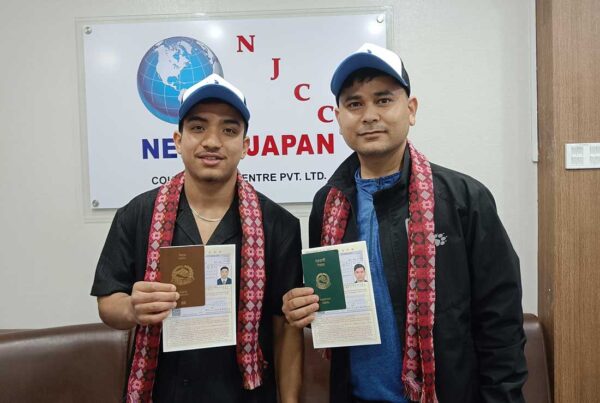
Nepal Japan Counselling Centre (NJCC) has been providing counselling services to Nepalese students since 2012. We are authorized by the Ministry of Education, Government of Nepal, and are members of ECAN as well. Our counsellors will help you in:
Selecting the best-suited MBA course and university for your profile
Pre-departure briefing and post-arrival assistance
If you are serious about your plan to study MBA in Japan, talk to our counsellors for a free consultation. Visit our contact page to book your session.
Is an MBA in Japan Worth It for Nepali Students?
Every big decision has trade-offs. Here is an honest look for Nepali students weighing this option.
It is worth it if:
You want to earn a degree that is recognized at a lower cost than in the USA, UK, and Australia.
You do not mind working in Japan since there is a good job market for MBAs.
You do not have trouble meeting the language requirement (English or Japanese).
You like stability and discipline in your work environment.
Think it through if:
You are on a tight budget, and there are no scholarships that you can get.
You are not comfortable with getting accustomed to the formal work culture in Japan.
You need fast ROI as making a career in Japan takes time.
Most students who have a clear career path and stable finances get value for their money when they study MBA in Japan.
Final Thoughts
Choosing to study MBA in Japan will offer you a good reputation, lower tuition than in the Western world, and global career opportunities. It will take some planning on your part, such as choosing a suitable university and organizing your visa paperwork.
An MBA in Japan is a good choice if your goal is to live, network, and work within Japan or for Japanese multinational firms. However, it generally offers a lower global return on investment compared to programs in the US, Europe, or India if you plan to work elsewhere
Which university is best for an MBA in Japan?
It really depends on what you want to achieve. Hitotsubashi ICS and Waseda Business School are two of the best-known institutions. The International University of Japan (IUJ) is the oldest all-English MBA program and the only Japanese institution ranked by The Economist among the world’s leading business schools. NUCB and APU are good choices at reasonable prices.
Is an MBA in Japan good for international students?
Yes. The MBA in Japan is well-respected throughout Asia and comes with good job opportunities with big companies. It is offered in English and hence can be done even if you don’t speak Japanese.
How much does an MBA in Japan cost for Nepali students?
The total cost will range from NPR 20 lakh to NPR 50 lakh per year, depending upon the city and university.
What GPA or score do I need for MBA admission in Japan?
Most universities do not have a defined minimum GPA requirement; however, a good academic transcript, IELTS/TOEFL score, and at least 2 years of working experience will increase your chances.
Can I work part-time while studying MBA in Japan?
Yes, international students are allowed to work part-time for a maximum of 28 hours per week during the semester with permission from the immigration authority.
Is GMAT compulsory for MBA in Japan?
Not necessarily. Some universities have this requirement, while some may exempt candidates with good professional experience and/or strong interviews from this requirement.
What is the best intake for MBA in Japan from Nepal?
Most programs run April and September intakes. Apply 6–9 months in advance to allow time for visa processing and document preparation.
Can I get a scholarship for MBA in Japan as a Nepali student?
Yes. Options include the MEXT Scholarship, JASSO stipends, and university-specific tuition waivers. Apply early, since scholarship deadlines often come before admission deadlines.
How long does it take to complete an MBA in Japan?
Most full-time MBA programs take 1 to 2 years. Part-time and Executive MBA programs can take longer, depending on your course load.
Can I stay in Japan after completing my MBA?
Yes. Graduates commonly move to a work visa, such as the Engineer/Specialist in Humanities visa, if they secure a job offer from a Japanese employer.