📞 01-4965681, 01-4965713 | ✉ injcc12012@gmail.com

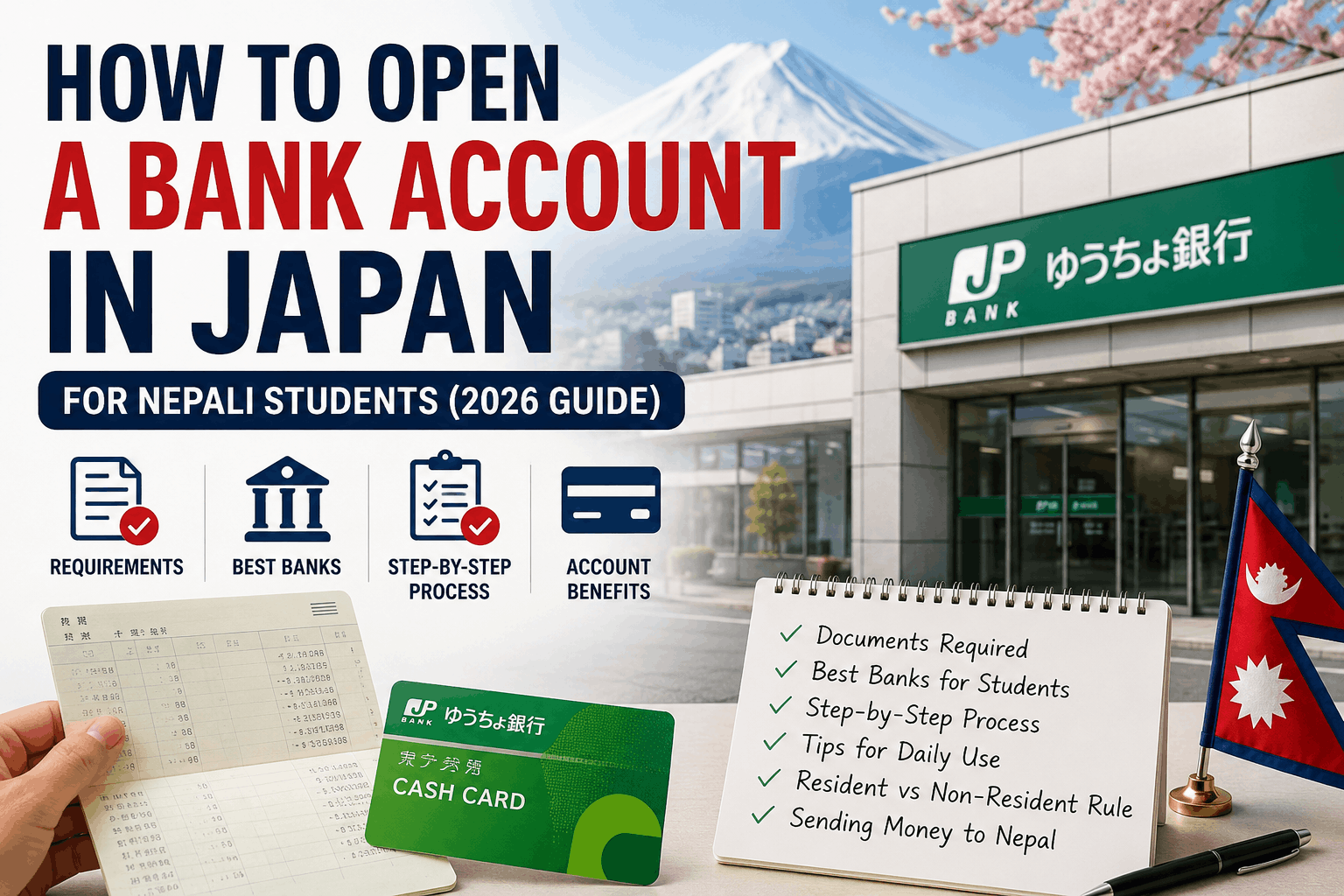
As soon as Nepali students arrive in Japan, they can open a bank account in Japan at a Japanese bank, enter their addresses and obtain a residence card. The easiest first account is Japan Post Bank (Yucho). It accepts new residents right away. It is also required at most of the Japanese universities for scholarship payments such as JASSO scholarships and MEXT scholarships. A residence card, passport, student ID or enrollment certificate, and a phone number in Japan are required. You’ll receive your bank book the same day. This cash card is delivered to you in the mail within 2-3 weeks.
If you are wondering how to open a bank account in Japan as a Nepali student, you should first understand the eligibility requirements, documents, banks, and application process.
Banking rules in Japan vary by branch. They are also dynamic and constantly evolving. As of mid-2026, the information in this guide comes from Japan Post Bank, University Student Offices and the Financial Services Agency (FSA) of Japan. Please check your bank’s requirements before applying.
Living in Japan on a cash basis is not sustainable for long. There are limits to cash-only living.
The language school or the university from which you are studying will probably require a bank account to receive payment or to pay back. If you are awarded a JASSO, MEXT or IGP scholarship, please consult your school. A lot of them will need a Japan Post Bank account to make these payments. Your salary will be paid directly to your account from your part-time employer. It will be used by your phone company and utility providers for monthly bills.
This guide will guide you through the entire process. It deals with the right bank for you. It includes which documents you should have and what you need to do. It also provides information about the resident/non-resident rules that determine when to send money home.
For Nepali students, having a bank account in Japan is an important part of managing everyday expenses, scholarships, salary payments, and other financial needs.
A few Japanese banking terms come up often. Learning them now saves confusion at the counter.
Most students cannot open an account on day one. Here is the realistic order of events:
As per the current guidelines for foreign residents of Japan in terms of banking, there are two banks that particularly accommodate newly arrived residents. These banks include the Japan Post Bank and the Seven Bank, which allow newly arrived residents to join as soon as the residence card and the address registration have been processed.
Not at all. It is mandatory for you to be physically present in Japan and to have a residence card registered at an address to open a personal bank account. This is true for Japan Post Bank, the big city banks, and even for digital banks.
Japan Post Bank serves as the preferred first bank account for many international students. This bank utilizes post offices all over Japan; therefore, there are branches even in rural areas surrounding language schools.
What makes it the practical first choice:
Limitation to take into consideration: the JP Bank Visa Debit Card is not the same as the cash card. It can only be obtained by foreign customers who have notified the bank of an intention to stay in the country for more than one year.
Seven Bank is an excellent option for a second bank account. The ATMs of Seven Bank are located within 7-Eleven stores throughout Japan, which facilitates the process of making withdrawals anytime, anywhere. Account opening is possible either online or through the use of supported ATMs. Seven Bank provides multi-language services and multilingual assistance. Foreign nationals who qualify for the account also receive a free JCB debit card.
The SBI Shinsei Bank is known to be the friendliest bank towards foreigners in terms of English proficiency, with its banking app and website being entirely in English. Most transactions can be conducted without going to any branch. This bank prefers that you have at least six months left during your stay in Japan. This is not the case with megabanks since they look at the number of years you have been living in Japan. There is also no minimum balance requirement in this bank.
PRESTIA is the foreign branch of SMBC. This branch is designed for customers who speak English. It provides English call centre services, online banking in English, and an application process that does not require a seal. The downside is the need for a minimum deposit amounting to about 100,000 yen to avoid bank fees. There are less branches and ATMs in PRESTIA compared to Japan Post Bank.
They are the largest banks in Japan. They provide excellent mobile banking service and country-wide ATM services. Proof of registration of your address is a must for most of them. In reality, most of them require proof of your stay in Japan for some time period. This is also known as the “six-month rule”. It is based on anti-money laundering regulations and not a single law. Some branches of Mizuho Bank may be lenient to employed applicants.
These banks work well as a second account, once you are settled and have a longer record of living in Japan.
| Bank | Best For | Typical Requirement | English Support | Notes |
| Japan Post Bank (Yucho) | First account; required for most scholarships | Residence card with registered address | Good; Japanese, English, Chinese, Vietnamese | Apply at a branch or via the Yucho Tetsuzuki App |
| Seven Bank | Easy digital setup, wide ATM access | Residence card required | Good, multilingual | ATMs inside 7-Eleven stores nationwide |
| SBI Shinsei Bank | English-first digital banking | Around 6 months remaining on visa | Full English platform | No minimum balance |
| SMBC Trust Bank PRESTIA | English support, multi-currency savings | Minimum deposit around ¥100,000 for fee-free status | Strong English support | No personal seal required |
| MUFG / SMBC / Mizuho | Long-term stays, larger balances | Often address registration plus a residency history | Moderate | Mizuho sometimes more flexible for employed applicants |
Bank policies frequently update. Verify the latest policies with the branch or the official website of the bank itself prior to making any application.
Bring the items listed below to your bank branch, or prepare them before submitting your app-based application. Slight variations will apply depending on the bank.
Standard document checklist:
If you do not yet possess a student ID card, then obtain a certificate of enrollment from the admissions office of your institution. Most banks will accept this certificate as an alternative until you obtain your ID.
Step 1: Register your address at the city or ward office: You need to do this within two weeks after moving into your place of stay. This will help you get your residence card, which needs to be updated before applying for a bank account.
Step 2: Get a Japanese phone number: Get a phone number from the phone provider before applying for an account.
Step 3: Gather your documents: Grab your residence card, passport, student ID or enrollment confirmation, and your phone number.
Step 4: Choose your method: Visit a branch, or for Japan Post Bank only, use their Yucho Tetsuzuki App instead. It uses the IC chip inside your residence card using your phone’s NFC chip. For all other banks, going to a branch office is the usual way when opening your first bank account.
Step 5: Complete the application: An employee at the branch will give you a document, usually in English at larger branches. Write your name in the same way as on your residence card.
Step 6: Submit your documents and wait for review: It takes 30-60 minutes to be processed through the counter.
Step 7: Receive your passbook: All banks in Japan provide you with a paper passbook (tsucho) on the same day. Some banks even offer a service of no-passbook banking.
Step 8: Wait for your cash card by mail: The cash card from the ATM comes to you via mail service at your address in 1-2 weeks. You cannot withdraw cash from the ATM without the card.
This is one of the least understood aspects of Japanese banking for newcomers, which is why I have allocated an entire section to explain it.
There is a bank regulation in Japan known as the Foreign Exchange and Foreign Trade Act. According to this regulation, foreign nationals are considered “non-residents” for the first six months of their stay in Japan. This is a banking term.
Being a non-resident, you can continue to operate your bank account as normal. You can deposit your salary. You can pay bills and make purchases. However, you are not able to send and receive international wire transfer transactions during this period.
After 6 months, your bank account status will be changed to “resident.” From now on, international transfers will be possible from your bank account.
This matters for two groups of students:
Once you are eligible for international money transfers, you usually have several choices available:
Compare the charges and the exchange rate simultaneously, and not only the charges. In some cases, a low charge but poor exchange rate will end up being more expensive compared to high charges but a reasonable exchange rate.
Opening a bank account in Japan is one of the first practical steps every Nepali student takes after arrival. It supports your scholarship payments, part-time job income, school fees, and daily bills. Start with Japan Post Bank or Seven Bank for a smooth first experience. Confirm your scholarship’s banking requirement with your school. Plan around the 6-month non-resident rule if you expect to send money home early in your stay.
At NJCC, we prepare students for this step long before departure through our pre-departure briefing and post-arrival support services. For detailed, personalized guidance on banking, housing, and settling into student life in Japan,contact NJCC for a free counseling session.
Yes. Foreigners can open a personal bank account in Japan provided that they are eligible for it. For that matter, you are required to have a Residence Card and an address in Japan. For students and technical interns, they need to present their student IDs and employee IDs as well.
Yes, there are some banks that do accept applications from eligible foreign residents through online or mobile application forms in Japan. For instance, Japan Post Bank enables eligible foreign residents who are 16 years and above and living in Japan to apply via the Japan Post application using their Residence Card.
The Japan Post Bank, SMBC, MUFG, as well as many other major Japanese banks, may suit your needs as a foreign resident. It would be convenient to choose Japan Post Bank as a new bank due to its extensive branch and ATM networks, along with some multilingual services. The best one for you will depend on various issues.
Most of the foreigners have to guarantee that they have their residence card and evidence of their address. It depends on what your status is and on the particular bank, but you can be required to present either your passport, your student card or your worker’s one, or maybe even your seal. Only one bank needs additional documents: Japan Post Bank.
There normally is no minimum amount for opening a basic personal bank account. The requirement at the Japan Post Bank, for instance, says that you may make the initial deposit of ¥0 upon opening an account. But requirements differ between different banks and different account types.
Yes. International students staying in Japan may be able to open an account if they fulfill the bank’s conditions. They would be required to provide their Residence Card, as well as proof of their student status through their student identification or enrollment certificate.
In general, you cannot open a regular Japanese resident bank account if you live outside of Japan since banks usually require confirmation of residence and identity in Japan. You will have to get into Japan, confirm your residence and receive the necessary identification documents before opening an account. Japan Post Bank, for example, allows only citizens of Japan to use the mobile application for account opening.
If you leave Japan forever, you may want to review the policy of your bank and close the account before leaving. Japan Post Bank recommends closing the account to people who go back to their home country or leave Japa