📞 01-4965681, 01-4965713 | ✉ injcc12012@gmail.com


Japan is one of the top choices for Nepali students who want to study abroad. Every year, many students choose to study in Japan because of its high-quality education and advanced technology.
Despite the standardized admissions process, many students become confused due to language barriers, documents, COE, and the Japanese student visa process.
This guide explains the full process of study in Japan simply and easily, based on real admission and visa procedures.
Nepalese students favor Japan as a study destination because of the quality of education, advanced technology, safety, and employment opportunities in the country. You can visit the guide, Why Choose Japan for Higher Studies for more details.
The education system in Japan is highly respected around the world for its strong research background, practical approach to learning, and industry connections. Some famous universities in Japan include Tokyo University, Kyoto University, Osaka University, and Hokkaido University.
The tuition cost, along with the other fees, is much lower than that of other nations such as America, England, and Australia. The government provides scholarships in Japan for Nepali students, and they can also get employment opportunities while studying.
Japan is one of the safest places in the world, offering security along with good transportation facilities to the students.
Japan suffers from labor shortages in industries like Information Technology, engineering, healthcare, and tourism, among others.
International students are allowed to work a maximum of 28 hours per week and full-time during holidays, if approved by the government. This will assist them in managing their finances and becoming accustomed to their environment.
Before undertaking the trip to Japan for education, the applicant needs to be aware of all the possible choices at his/her disposal. This would depend on various elements, including academic qualifications, linguistic abilities, and professional goals.
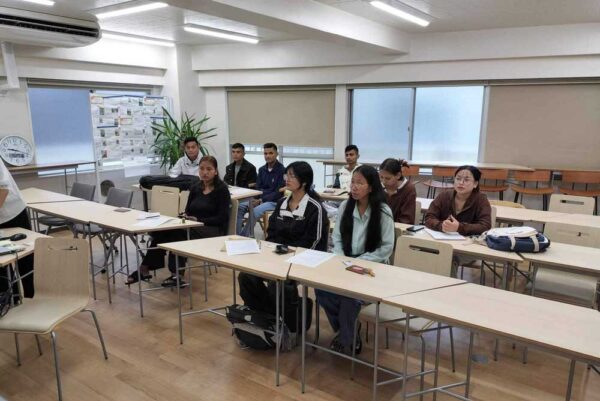
The majority of Nepalese candidates begin their education in Japan by joining Japanese language schools. Schools like this can be beneficial in preparing you for your higher education and life in Japan.
The following are what Japanese language schools mainly focus on:
This is the most popular and preferred route into the Japanese education system for new students.
Candidates with a minimum educational qualification of +2 or above are eligible to apply for undergraduate studies in Japan.
Universities provide:
This route would suit students who want to start the undergraduate course right away without going through a language school first.
Those who have already completed their undergraduate degree can now join postgraduate programs in Japan.
Below are some of the things that you may need for the application process for your master’s degree and PhD studies:
Japan’s postgraduate degrees are research-based, which requires collaboration with your mentors and industrial experts.
In Japan, Senmon Gakkou is an institution that provides vocational training with skill-oriented education in order to prepare individuals for the workforce.
Such an institution would be ideal for learners who would like to develop practical skills instead of academic skills. The vocational training system in Japan is highly practical.
Fields of study for vocational education include:
The greatest strength of vocational educational institutions in Japan lies in their practicality and career-focused orientation. The students here get practical knowledge and gain experience in their professional field, which serves as a perfect channel for entering the Japanese labor market.
The admission policies vary from one institution of learning to another in Japan, although every track is associated with certain requirements that need to be fulfilled first.
Language institutes usually offer flexible academic criteria since their primary aim is to prepare students for further study in Japan.
Language proficiency is a very important criterion for study in Japan. This will depend on the language of instruction for the course.
Japanese proficiency is required in the majority of Japanese programs. Sample Japanese Language Proficiency Test (JLPT) qualifications are listed below:
If you have a higher JLPT qualification, you have a greater chance of getting accepted, and this will help you greatly with your life in Japan as well as while working there.
Some universities in Japan offer English-language courses that are suitable for international students.
The following is the general requirement for such courses:
Courses conducted in English offer less flexibility compared to courses conducted in Japanese; hence, it is advisable for potential students to learn the basics of Japanese.
Choosing the right institution is very important in terms of your studies in Japan, as the choice will affect whether you obtain a visa, the type of education you get, and job prospects in the future.
Institution choices differ based on education levels as well as plans. Choices for Nepali students include:
Documentation plays an extremely important role in all of the procedures involved in obtaining entry into universities in Japan. Documentation mistakes will have an impact on both admission and obtaining a visa entry into Japan.
A passport with sufficient validity is required when applying for admission and obtaining a visa.
Academic certificates like SEE, +2, bachelor’s degree, or any relevant certificates, depending on the level of education you desire to get.
Academic transcripts/mark sheets obtained from previous studies done in colleges/universities.
A letter indicating your purpose of study, why you have chosen Japan for further education, and your future plans.
A letter written either by your professors or institutions to recommend your admission.
Recent photographs according to application requirements.
Required for identification.
The bank statement and other financial documents regarding your capability to pay for tuition fees and living expenses in Japan.
One of the important things that must be taken into account during the process of studying in Japan is proof of one’s capability to afford studies and living in Japan. This guarantees that the student will not experience any financial difficulties while studying at the university.
The general requirement with respect to financial evidence for Nepalese students to get a student visa would generally be around:
It is thought that this is sufficient to cover costs for both studies and accommodation within the first year in Japan.
There may be times when even a higher level of financial security will be needed, depending on the length of the course and the location of the institution.
A Statement of Purpose (SOP) may very well be considered as one of the most significant documents for applying for admission in Japan. The SOP is highly significant not only for choosing the right university but also for issuing the student’s visa.
A well-written SOP must possess the characteristics of clarity, coherence, and integrity. The educational institutions and immigration authorities of Japan would appreciate clarity, common sense, and truth rather than exaggerations.
State what draws you to studying in Japan – could be anything from culture to education.
Explain your interest in the field and how the course fits into your future plans.
A short summary of your academic background is sufficient.
Share your career objectives after you have completed your studies.
Include your education and accommodation expenses, along with any sponsorships, if applicable.
Clearly indicate your plans on returning to Nepal upon completion of your education or on utilizing your skills at home.
Once all the documents have been prepared and checked, the next step will be to apply for admission at the desired institution in Japan.
Choose the desired language institutes, universities, and/or vocational institutions that you want to study in and apply to them accordingly, either directly or through a representative.
Ensure that all necessary documents related to academics as well as finances are submitted according to the guidelines of the institute. Detail-orientedness becomes important in this step.
The institution might conduct interviews, either virtually or face-to-face, to understand your motivation and language skills.
If your application turns out to be successful, you will be provided with a letter of admission from the college.
A Certificate of Eligibility (COE) is one of the most essential documents when applying for the Japanese Student Visa. The COE serves as an officially recognized document certifying that the student is eligible to study in Japan.
COE, or Certificate of Eligibility, is a legal document that serves as proof that the individual meets all the criteria needed to come to Japan as a student. The COE is vital to obtain a student visa.
The applicant cannot apply directly for the COE. It is the Japanese educational establishment where the applicant would be studying that will apply for the applicant after he/she has been admitted. The applicant’s educational establishment will submit all required paperwork for Japanese immigration clearance.
Without a COE, a candidate is unable to acquire the Japanese student visa from the Embassy of Japan, Nepal. The COE application is therefore one of the crucial processes during the admission procedure.
Once you obtain the Certificate of Eligibility (COE), it’s time to apply for a Japan student visa from Nepal. This can be done via the Embassy of Japan in Nepal, and generally, there shouldn’t be any issues as long as everything is completed correctly.
Submit your visa application to the embassy after getting your Certificate of Eligibility.
In some cases, applicants may be called for a short interview to verify study intentions and documents.
If documents are correct, the approval rate is generally high.
The Nepali students who wish to pursue studies abroad, including in Japan, need to have a No Objection Certificate (NOC). This certificate is an important and compulsory document for the procedure of foreign study.
NOC is the legal clearance issued by the Nepalese government to students intending to go abroad for further education. The NOC should be taken because:
After the successful issuance of the student visa, the next step is preparing for the journey to Japan. Adequate preparation can help one to easily get used to the new environment.
After reaching Japan, students have to undertake specific steps to ensure that their status as international students is recognized officially.
After landing in international airports in Japan, eligible students will get their Residence Card through the immigration authority. This Residence Card will serve as an identity card in Japan and should be kept by the owner at all times.
This card is important for:
After settling down at the location where you will be living, according to the legal requirement, you need to register yourself within 14 days at the municipality office located in the city.
This helps in the proper registration of foreign residents in Japan and is also essential in availing of different facilities.
The opening of an account at a Japanese bank is vital in the management of financial transactions. This includes:
Students normally register a bank account once they register their residence.
Foreign students enrolled in universities in Japan are allowed to work part-time as per specific guidelines set by the government of Japan. In this way, the foreign students can manage their expenses and gain valuable work experience.
The following jobs are common for international students:
The wages for working an hour depend on location, occupation, and experience.
In addition to satisfying monetary demands, part-time employment is beneficial for students who wish to improve their fluency in Japanese.
Some scholarships in Japan can help Nepalese students save costs while studying and living in Japan.
The MEXT scholarship is fully funded by the government of Japan. The cost of tuition fee, monthly stipend, return fare, and medical insurance is borne by the scholarship. This is a highly competitive scholarship that is awarded to excellent, goal-driven students only.
JASSO Scholarship offers funding every month for international students who study in Japan. The majority of scholarships are granted through the universities themselves or through other exchange programs.
Japanese universities offer their own scholarships. It can come from a lowering of tuition or through monthly allowances.
Private organizations and companies give out scholarships to international students who wish to study in Japan. These private scholarships have limited funding but can be helpful in covering basic needs like rent and food.
The cost of studying in Japan is not constant because it varies depending on the institution, course, and even the city one decides to study in. In general, tuition fees in Japan are cheaper compared to the US and UK. Moreover, you can earn scholarships and work while studying in Japan.
The tuition fee may depend on whether the institution is private or public, as well as the choice of courses.
On average, monthly living expenses come to approximately JPY 80,000 to 120,000.
Studying in Japan from Nepal is a structured and rewarding journey that becomes easier with proper planning, documentation, and guidance. By understanding key steps such as COE, financial requirements, and visa procedures, students can successfully secure admission in Japanese institutions.
With multiple study pathways and strong career opportunities, Japan remains one of the best destinations for Nepali students seeking quality education and global exposure.
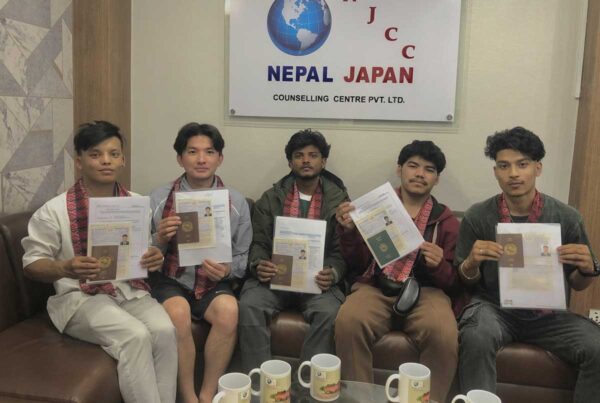
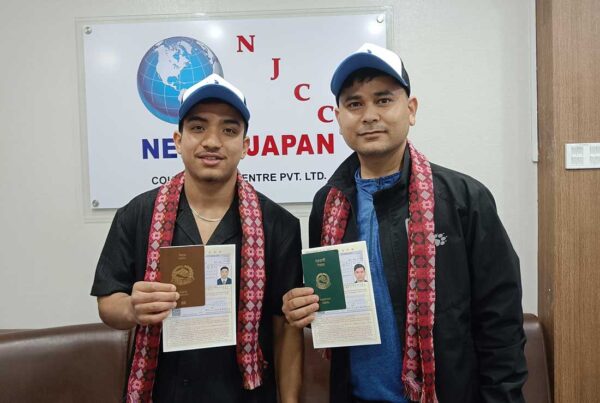
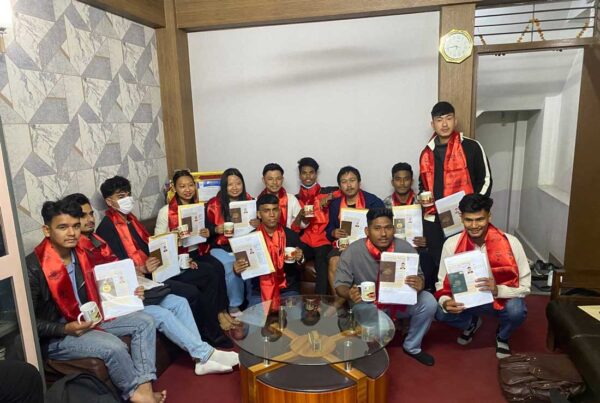
If you are planning to study in Japan, NJCC is here to guide you from application to visa support.
Contact NJCC today and begin your study journey in Japan with confidence.
The cost of studying in Japan will depend on the college and the way of life. The annual tuition cost ranges between JPY 600,000 and JPY 1,200,000, while the monthly cost of living is JPY 80,000 to JPY 120,000. Language schools tend to be cheaper than universities.
Japanese schools usually have a minimum GPA requirement of about 2.5 to 3.0 (scale of 4.0) or an equivalent level of academic achievement. Nevertheless, the criteria may differ from one university and course to another.
To earn a fully sponsored scholarship such as the MEXT Scholarship, one needs to have outstanding academic performance, a good command of English and/or Japanese, and an elaborate application. It should be noted that there are tests and interviews involved, making it quite a competitive process.
Yes, Japan is indeed among the top countries for Nepalese students owing to its advanced educational system, safety, technology, and job prospects. Besides, there are also options for working during studies along with scholarships for foreign students.
Yes, students who are studying abroad in Japan can work up to 28 hours per week while they are studying. Moreover, they can work full-time when they have holidays from their studies. This allows the student to earn some money for his/her personal needs.
It may not be compulsory, particularly for English-based programs. Nevertheless, studying some basics of the Japanese language (JLPT N5/N4 level) is strongly suggested since it will benefit you in your daily activities, academics, and part-time work.