📞 01-4965681, 01-4965713 | ✉ injcc12012@gmail.com

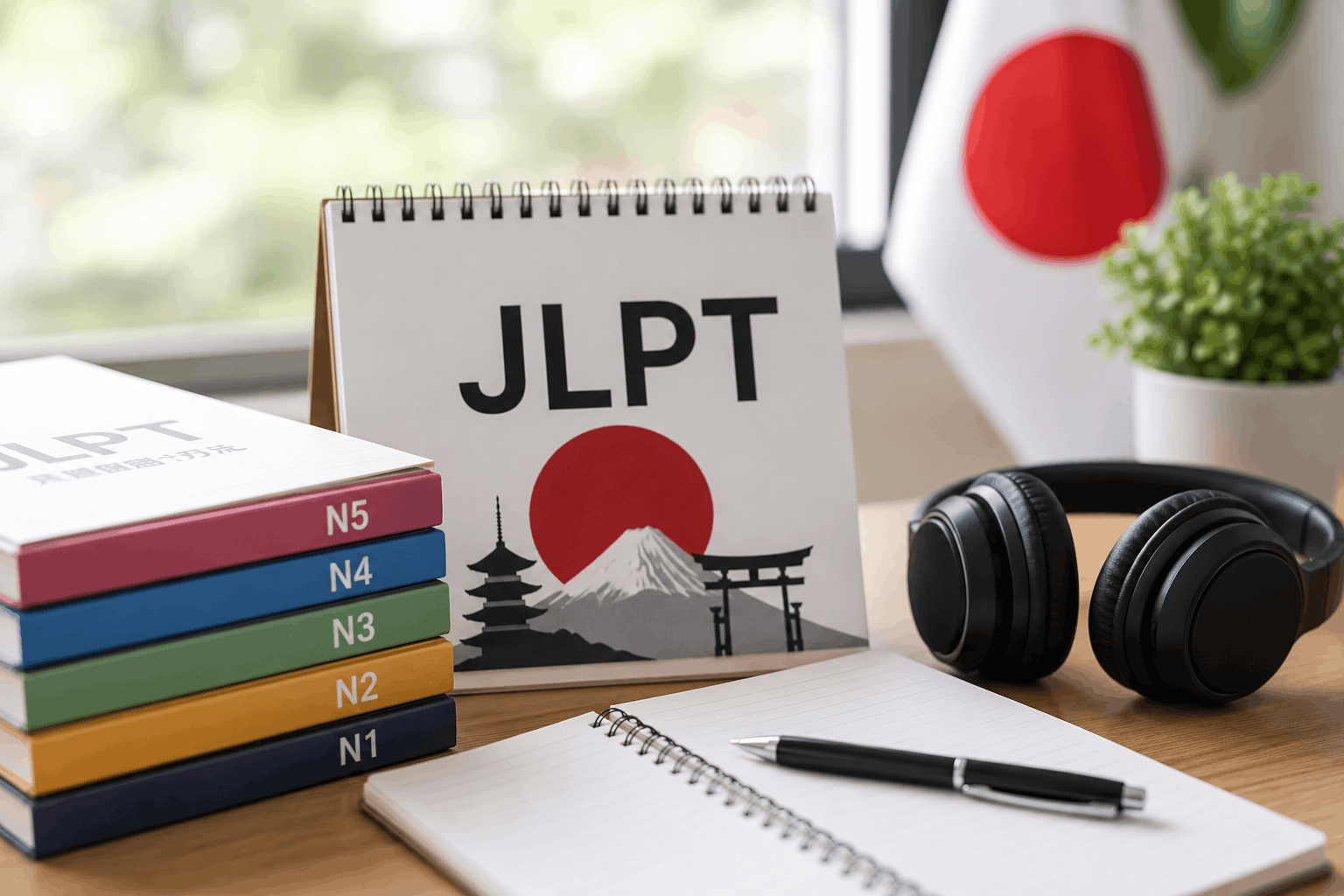
Planning to study in Japan? The first step toward achieving your goal is to begin your JLPT preparation in Nepal, and that starts with understanding the Japanese Language Proficiency Test (JLPT) itself. This test is a globally recognized test that evaluates Japanese language skills at five levels, starting from N5 (Beginner) to N1 (Advanced). Most Nepali students begin their journey with JLPT N5 and can usually prepare for the exam within 4–6 months through consistent study.
This comprehensive guide contains information regarding the JLPT exam Levels, JLPT Registration in Nepal, Exam Fees, Test Centers, the JLPT N5 Level Study plan, some book recommendations, Free Learning materials and some expert advice on JLPT Preparation in Nepal.
The JLPT (Japanese-Language Proficiency Test) is the most common test for Japanese language proficiency among people who do not speak Japanese. The JLPT was established in 1984 and is coordinated by The Japan Foundation and Japan Educational Exchanges and Services (JEES). Today, there are more than 85 countries and regions, including Nepal, where the JLPT is being conducted.
There are three parts to the JLPT: Language Knowledge (Vocabulary and Grammar), Reading, and Listening. The JLPT test is not based on one’s memorization but rather on comprehension and usage of the Japanese language in practical situations. One’s knowledge and skills in the Japanese language can be certified through the JLPT examination regardless of whether he or she is studying, working, or residing in Japan, and a JLPT certificate might help improve his or her chances when applying to educational institutions and jobs involving Japanese language skills.
Nepalese students generally ask themselves if it is important to sit for the Japanese Language Proficiency Test (JLPT) before coming to Japan. Even though the JLPT is not a requirement in some educational institutions and even for some student visas, it still has several advantages.
JLPT certification shows how serious you are about learning the Japanese language. This will prove to the academic institutions that you have started to develop the language skills required for studies in Japan.
In some cases, certain Japanese institutions may consider an individual’s Japanese language skills during acceptance or selection of candidates, especially in the case of Japanese institutions which offer their courses in Japanese. It is always wise to ensure that one meets the requirements set by the institution or specific scholarship.
In many cases in Japan, employers favour those applicants who can speak Japanese to some extent. Knowing even the N5 or N4 level can give you confidence while seeking employment in part-time jobs like restaurants, convenience stores, and supermarkets.
Learning Japanese will allow you to communicate with your teachers, peers, and local people. It will also make things easier for you regarding communication in routine activities like shopping, transportation, and filling out paperwork.
With your increased Japanese language competence, many academic and job openings will be at your disposal. Increasing levels of JLPT, especially those of N2 and N1, are widely accepted by companies and may prove beneficial for positions requiring Japanese language knowledge.
The Japanese Language Proficiency Test (JLPT) has been designed using five levels. As a result, it is easier for you to move ahead from basic to advanced Japanese language learning. The test aims to evaluate your language proficiency in varied real-life situations.
| Level | Suitable For | Language Ability |
| N5 | Complete beginners | Understands basic greetings, simple vocabulary, and beginner-level grammar. |
| N4 | Elementary learners | Can understand everyday conversations and read short, simple texts. |
| N3 | Intermediate learners | Able to understand daily conversations, workplace communication, and simple newspaper articles. |
| N2 | Advanced learners | Suitable for university studies and professional work requiring strong Japanese skills. |
| N1 | Advanced to expert users | Can understand complex academic, professional, and business-level Japanese. |
For most Nepali students looking to study in Japan, JLPT N5 would be the best choice to start with. It will help you get a good base in Japanese and prepare for future levels of JLPT exams.
Selecting the correct JLPT test level depends on the individual’s present Japanese language abilities as well as their objectives. Taking the JLPT test from the appropriate level will boost confidence and increase the probability of passing.
Pick JLPT N5 if you are a complete beginner in the language or just finished your course at a beginner level. It covers basic vocabulary, grammar, Hiragana, Katakana, and simple daily conversations, making it ideal for beginners starting JLPT Preparation in Nepal.
JLPT N4 is ideal for those who know the basics of grammar, can read simple Japanese text, and have equivalent knowledge of N5.
Select JLPT N3 if you can communicate in various real-life situations, comprehend extended conversations, and wish to further enhance your Japanese language abilities for further studies and career advancement.
JLPT N2 is suitable for those who intend to pursue their studies in Japanese universities or work in professions that need good knowledge of the Japanese language. Several companies and organizations in Japan consider N2 as a practical proficiency level in Japanese.
JLPT N1 is the highest level and is for the more advanced students who can understand complicated Japanese used in business and other professional settings.
Tip: If you are a beginner in the Japanese language, then you should go for JLPT N5. It is recommended that you select an appropriate JLPT level according to your proficiency level. JALTAN does not permit changes to chosen JLPT levels once a candidate has registered. Thus, you need to choose a level carefully.
In Nepal, the JLPT is organized by the Japanese Language Teachers’ Association Nepal (JALTAN), based at Bishwa Bhasa Campus, Exhibition Road, Kathmandu.
Always confirm the exact venue and date on JALTAN’s official notice for your specific exam cycle, since arrangements can shift slightly each session.
JLPT registration in Nepal is organised by the Japanese Language Teachers’ Association Nepal (JALTAN). The registration process starts about 2–3 months before the July and December exams. Therefore, it’s necessary to follow the official announcements and register as soon as possible.
Access jlpt.org.np or jaltan.org.np for the official registration announcement. This announcement contains vital information related to the registration period, exam schedule, required documents, examination fees, etc.
Fill out the online application form with the help of your personal information carefully. Remember that your name, date of birth and all other information must match your passport or citizenship document so that there is no problem during registration.
Upload the documents that have been mentioned in the official notice, usually a recent passport-size photograph along with a valid ID proof. Ensure that your photograph fulfils the requirements of JALTAN before applying.
Complete the payment according to the payment process mentioned in the formal registration notice. In the latest cycle of examinations, the JLPT exam fee in Nepal is Rs. 3,000, and the payment process is through Khalti Wallet. As there is a possibility that fees and payment modes could be changed, it is important to confirm the information.
Once your application gets approval, download your admit card from the official registration website. Verify your personal information, chosen JLPT level, reporting time, and exam centre location, and retain your admit card for the exam.
Making minor mistakes during the JLPT registration in Nepal might cause unnecessary delays or even disqualification of applications. To avoid these problems during registration, you should avoid the following mistakes:
Tip: Early JLPT registration in Nepal will give you ample time to fix all the problems that may arise in your application.
Many learners who begin studying Japanese ask the question, “How many months will I need to be ready for the JLPT N5 test?” Although everybody has their own speed of studying, the period between 4 and 6 months of steady studying can be estimated for most beginners from Nepal.
Begin your study with the two basic scripts in Japan: Hiragana and Katakana. Learn simple greetings, numbers, dates, self-introductions, and daily vocabulary.
Goal:
Start learning important grammar structures like です (desu), ます (masu), particles, demonstratives, and question forms. Begin to learn some kanji while studying grammar at the same time.
Goal:
Practice by reading through short texts, listening to easy dialogues, and comprehending basic sentence structures. Keep on building up your vocabulary and kanji knowledge through beginner-level JLPT questions.
Goal:
At this point, you would have completed most of the grammar lessons in the JLPT N5. You aim to revise all the lessons that you have learned from reading, listening, and grammar rather than starting a new one.
Goal:
Begin taking at least one complete mock test for JLPT N5 every week. Analyze all the mistakes and determine the topics which require more practice. This is also an ideal period to work on your time management skills.
During the last month, work on building your confidence level. Work on revising the vocabulary, grammar, kanji, reading, and listening daily. Do practice tests that you have done earlier, and do not study any new material in the last week before the test.
Tip: Get enough sleep, stay relaxed, and focus on consistent revision rather than last-minute cramming.
An organized study schedule will assist you in staying on track and not cram at the last moment. Regardless of whether you are a student or work part-time, an organized weekly schedule will ensure that you study all parts of the JLPT N5 curriculum.
| Day | Study Focus |
| Monday | Revise Hiragana, Katakana, and learn new vocabulary |
| Tuesday | Practice grammar lessons and sentence patterns |
| Wednesday | Learn and revise kanji with writing practice |
| Thursday | Improve listening skills using beginner-level Japanese audio |
| Friday | Practice reading comprehension and short passages |
| Saturday | Revise vocabulary, grammar, and kanji learned during the week |
| Sunday | Take a full or sectional mock test and review your mistakes |
Study Tip: Try to study for 1-2 hours daily. Daily study is better than studying for long periods of time only on weekends.
The right study materials can make your JLPT Preparation in Nepal much more effective. Whether you’re enrolled in Japanese language classes in Nepal or preparing independently, these books are highly recommended for JLPT N5.
| Book | Best For | Why It’s Recommended |
| Minna no Nihongo | Classroom learning | Most popular textbook among many Japanese language institutes. The textbook provides structured lessons on grammar, vocabulary, listening and classroom activities. |
| Genki I | Self-study and beginners | Popular because of its clear explanation and balanced way of learning grammar, vocabulary, reading, and listening. |
| TRY! JLPT N5 | Grammar practice | Helps reinforce grammar concepts through practical examples and exercises, making it ideal for revision after learning the basics. |
| Official JLPT Practice Workbook | Mock tests and exam preparation | Developed by the official JLPT organizers, this workbook helps you understand the exam format, question patterns, and time management. Completing at least one official practice test before the exam is highly recommended. |
Study Tip: Do not stick to just one book. Study from a book such as Minna no Nihongo or Genki I, along with the Official JLPT Practice Workbook to gain knowledge and understanding of how the exam works.
As regards vocabulary, you should employ such applications as Anki and Memrise to help you remember new words due to their technique of spaced repetition. As far as grammar is concerned, you may use good grammar websites with N5 and examples to learn one grammar point per day. Finally, as far as listening is concerned, you should spend 15-20 minutes a day listening to Japanese.
One of the most frequent questions that arise from beginners preparing for the JLPT is: “How many hours should I study every day?” This is highly individual and depends on your level and when you are planning to take the exam.
Below you will find the study schedule that will be useful in case you are preparing for JLPT N5:
| Daily Study Time | Recommended Preparation Period |
| 1 hour per day | Around 6 months |
| 2 hours per day | Around 4–5 months |
| 3 hours per day | Around 3–4 months |
If you have chosen to attend Japanese language classes, devote your self-study time to vocabulary, grammar, kanji and listening revision, rather than learning new things.
Study tip: 30-60 minutes of daily study is better than several hours of study two times per week. Try to include vocabulary revision, grammar studies, reading and listening into your daily study routine.
Preparing well on the exam day can help you remain calm during the test. You must carry all the items you will require when you leave for the exam.
Exam Hint: Do not panic if you don’t know all the answers. Attempt the questions which you know first and go back to the tough ones later.
JLPT N5 is a big accomplishment; however, this is just the start of your Japanese language learning experience. The validity of your JLPT certificate is lifelong. Therefore, there is no need to take the exam again once you have passed it.
Many people, after successfully taking JLPT N5, start preparing for JLPT N4 to enhance their communication skills and increase their confidence in Japanese. As you develop more skills, you will be able to:
Keep in mind that learning Japanese is a slow process. There is nothing wrong with not passing the test the first time and trying again.
Preparation for the Japanese-Language Proficiency Test (JLPT) might be difficult if you are learning the Japanese language for the first time. NJCC will provide a guided approach to enable Nepali students to develop good language skills and be ready for the JLPT exam.
Here is how we help with your preparation for the JLPT:
Our Japanese Language classes are based on the JLPT N5 to N1 curriculum, allowing students to gradually enhance their linguistic proficiency.
Get trained by expert teachers who are well-aware of the JLPT exam pattern and the requirements of Nepalese learners.
Prepare yourself with periodic mock tests that will mimic the actual JLPT exam and help you boost your performance.
Our classes focus on all key areas of the JLPT, including:
Our team helps students understand the registration process of the JLPT, required documentation, deadlines, and test procedures.
Apart from helping with JLPT preparation, NJCC can also assist with:
Be it your first time preparing for the JLPT or studying in Japan, NJCC will support you all the way.
JLPT Preparation in Nepal is not simply taking a test but knowing everything about the language abilities that will enable you to survive when you study and work in Japan. It is constant reading of good study resources and regular practice tests that will give you the best results, and information about registration to JALTAN test is an additional advantage.
Ready to start your JLPT preparation? If you want structured guidance, mock tests, and expert support, NJCC’s Japanese language programs can help you build the skills and confidence you need both for the exam and for life in Japan.
Japanese-Language Proficiency Test (JLPT) is an international test which evaluates the level of Japanese language proficiency of non-native speakers at five different levels from N5 (beginner) to N1 (advanced).
Japanese-Language Proficiency Test (JLPT) in Nepal is organized by the Japanese Language Teachers’ Association Nepal (JALTAN), located at Bishwa Bhasa Campus, Exhibition Road, Kathmandu. Information about JLPT can be found at jlpt.org.np and jaltan.org.np.
No, not necessarily. Some institutions offering Japanese language courses do not require a JLPT certificate from their candidates; however, possessing N5/N4 is beneficial.
For beginners, JLPT N5 would be appropriate. It tests the basic knowledge of vocabulary, grammar, reading, and listening skills.
Beginners require 4–6 months of consistent preparation, during which one spends 1–2 hours a day on learning vocabulary, grammar, listening, and reading.
The recent JALTAN tests have fixed the cost at Rs. 3,000, which can be paid using Khalti Wallet. One needs to check the latest figure from the notice, as the fee might change from cycle to cycle.
JLPT is a level-based certification with five levels (N5–N1) and is generally held twice a year. JPT (Japanese Proficiency Test) is a score-based exam that awards a score from 10 to 990 instead of levels. JLPT is more widely recognized by Japanese universities, employers, and immigration authorities for study and employment purposes.
No. Once you have passed at any JLPT level, the certificate is permanent; you will never be asked to renew or retake it.
There’s no limit. You can attempt the JLPT as many times as you need, and most students progress gradually from N5 up to N1 over several sittings.
Yes. Many students succeed through self-study with books and practice tests, though a structured course adds guidance, regular assessments, and speaking practice.
Minna no Nihongo, Genki I, TRY! JLPT N5, and the Official JLPT Practice Workbook are the most recommended, covering vocabulary, grammar, reading, and listening.
No. JLPT tests language knowledge, reading comprehension, and listening comprehension; there’s no separate speaking or writing section.
Continue toward JLPT N4, practice daily conversation, read simple Japanese materials, and keep strengthening your listening skills.