📞 01-4965681, 01-4965713 | ✉ injcc12012@gmail.com

Japan ranks among the top study destinations for Nepali students who are planning to apply for a Japan student visa for higher education. It is well-known for its technological innovations, quality education, and research-oriented institutions. Students choose Japan for programs in fields such as engineering, information technology, business, robotics, and artificial intelligence. A Japan student visa from Nepal is an important initial step.
Japan is known for offering affordable education, security, and great employment prospects, making it a popular destination for study in Japan from Nepal. Most educational institutions offer courses in English, and students are permitted to work part-time up to 28 hours weekly. Additionally, scholarships in Japan serve to cut down on education expenses.
The student visa application process for Japan comprises admissions, financial documents, and COE approval. The requirements are better organized now for 2026, especially for financial documentation. With NJCC’s assistance, students can apply with ease and success.
Japan student visa refers to the long-term visa issued to foreign students who wish to study in Japan for more than three months. This type of visa enables students to stay in Japan so as to pursue their academic program fully. The student is also allowed to work during his/her spare time.
A Japan study visa is mandatory for students who are enrolling in a full-time course of studies, such as a bachelor’s, master’s, or even a doctoral program. This visa is also mandatory for students studying at language schools or vocational schools whose duration exceeds more than 90 days.
Any individual intending to pursue study in Japan must ensure that they have the correct Japan student visa for Nepali students before entry. Failure to have an appropriate student visa for Japan will make one ineligible to study there.
One of the key requirements is the Certificate of Eligibility (COE) under the Japan COE visa process, issued by a Japanese institution before visa application at the embassy.
Before studying in Japan, students need to fully understand Japan student visa requirements. Academic requirements, language requirements, and overall requirements are some of the important requirements that must be fulfilled by students. Fulfillment of these requirements will lead to the successful approval of the COE.
For undergraduate courses, applicants are supposed to be high-school graduates or must have undergone twelve years of schooling. Postgraduate and research courses require applicants to be holders of bachelor’s degrees in the respective subjects. Applicants interested in studying languages must also satisfy educational entry requirements, including being secondary school graduates.
For English programs, IELTS or TOEFL may be required under the IELTS for Japan student visa guidelines. For Japanese programs, JLPT is required under the JLPT Japan language requirement.
Applicants must submit an SOP under SOP for Japan student visa Nepal explaining study goals and career plans. A clean immigration history improves chances of Japan visa approval.
The Japan student visa application is based greatly on providing correct information through complete documents. Any little error made by the applicant could make him fail to acquire the visa or even cause the application process to take much longer. A valid passport is one of the important requirements.
The passport needs to be valid for a minimum period of six months with empty visa pages. In case your passport is not valid, the application process will fail.
A visa application form with complete details is required to fill out. It needs to be completed and signed. All information must be correct.
A recent photograph of the applicant in passport format must comply with the official size and background requirements of the Japanese Embassy.
This is the crucial document required for obtaining a Japanese student visa. The COE will be provided to you by your Japanese institution along with your visa application form.
A formal acceptance letter or admission letter from an officially approved Japanese educational institute is necessary.
The applicants need to prove financial capability by submitting bank statements, a salary certificate, fixed deposit slips, or a loan sanction from any educational institution.
All the academic documents related to previous studies, including certificates, transcripts, and mark sheets, should be submitted.
It is important to have an SOP that outlines the purpose of your study, course selection, and plans after completion for your application to be considered.
Evidence of the payment of the visa application fees is mandatory.
Further supporting documents might be requested by the embassy.
The Japan student visa processing time is divided into two main categories. The first one involves the issuance of a COE from Japan, and the second process is visa stamping by the Japanese Embassy.
COE is requested by your school in Japan on your behalf. Generally, it requires about 4 to 8 weeks, based on immigration load and admission cycle. Without a COE, you cannot apply for your visa.
After the approval of the COE, you can proceed with applying for your Japanese student visa stamping. The whole process will normally take about 5 to 10 working days.
In order to avoid any kind of delay, students are recommended to apply a minimum of 2-3 months before their start of studies date.
Proper counseling from organizations such as NJCC would allow students to go through the whole Japan student visa application procedure without any hassles.
Before you begin your study in Japan, it is crucial to understand the total amount required for a Japan student visa for Nepal because visa fees make up a mere fraction of the total cost. There are many other expenses that students have to take into consideration.
The Embassy of Japan in Nepal costs around NPR 1,600 for a single-entry visa and approximately NPR 3,200 for a multiple-entry visa. But generally, student visas are provided on a single-entry basis only.
This fee is paid at the time of submitting visa documents to the embassy; this is the official embassy fee and not refundable in any case.
The cost of applying to Japanese institutions ranges between JPY 20,000 – 30,000 (approximately NPR 20,000 – 30,000). The fee caters to the processing of your application and COE request.
3. Certificate of Eligibility (COE) Processing
The COE will be processed in Japan on your behalf by your institution. The immigration fee will be paid by your institution, but some consultancies in Nepal charge you fees for COE processing.
Students also need to prepare supporting documents, which may cost:
Consultancy service charges may vary between NPR 30,000 to 80,000 based on the service offered.
Consultancies generally provide services like document verification, applying for the school, COE arrangement, embassy visit, and interview preparations.
6. Language Test Fees
JLPT or NAT-TEST registration fees will be charged if you want to take the test. Fees for the JLPT in Nepal are approximately NPR 3,500-5,000. Some students also require IELTS for English-medium education, and the fee is approximately NPR 22,000-25,00
Flights from Nepal to Japan (Tokyo/Osaka) on a one-way ticket normally range in price between NPR 60,000-100,000.
Students need to bring a budget amount of JPY 200,000-300,000 (NPR 2-3 Lakh) for covering initial expenses such as accommodation, food, and transportation.
While the cost of a Japanese student visa from Nepal is inexpensive, it is part of the total amount of study-related costs.
The Japan student visa application process from Nepal is broadly classified into two phases: the initial stage involves receiving the Certificate of Eligibility from Japan, while the latter entails filing for a visa at the Japanese embassy in Nepal.
Below is a brief guide on how this whole procedure works.
| Rank | Name of University | QS World University Rankings |
| 1 | The University of Tokyo | 36 |
| 2 | Kyoto University | 57 |
| 3 | Tokyo Institute of Technology (Tokyo Tech) | 85 |
| 4 | Osaka University | 91 |
| 5 | Tohoku University | 109 |
| 6 | Nagoya University | 164 |
| 7 | Hokkaido University | 170 |
| 8 | Kyushu University | 170 |
| 9 | Waseda University | 196 |
| 10 | Keio University | 215 |
Japan student visa can be rejected if the requirements for issuance of Japan student visa are not met in accordance with the policies set by the Embassy of Japan. There is a need for the students to be aware of the basics in order to get their Japan student visa without any mistakes.
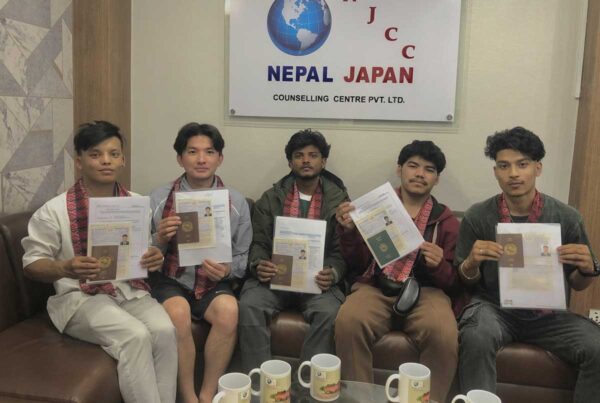
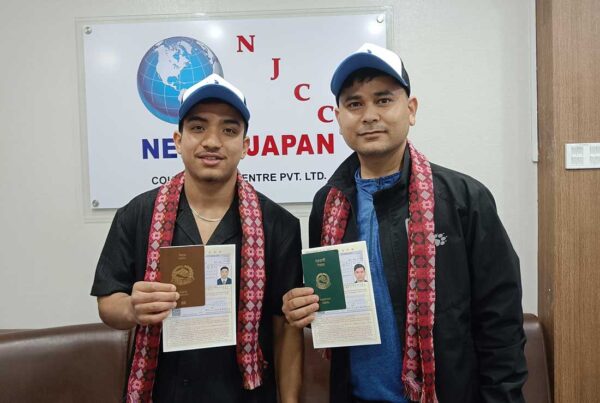
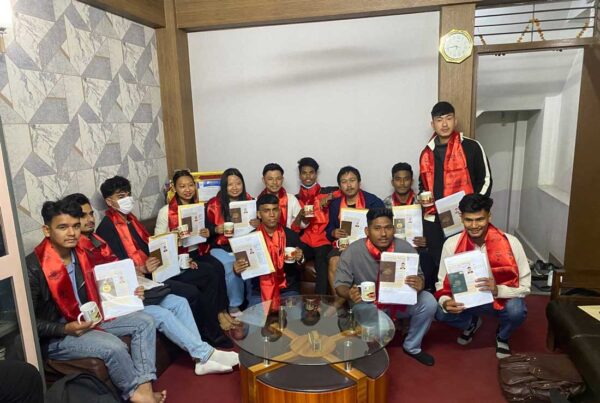
NJCC assists in selecting the best Japanese schools, colleges, and universities where students can study in accordance with their qualifications and financial situation as well as the purpose of studying in Japan. Hence, it makes it easy for the students to enroll themselves into the best programs to study in Japan.
NJCC guides the applicants comprehensively through the process of getting a visa to Japan from Nepal, making sure that the student knows each and every step in this process.
NJCC will help the applicants with preparing all documents required for getting the Certificate of Eligibility (COE). This is one of the most important parts of the visa process to Japan.
The NJCC assists in verifying all the academic documents, financial documents, and the Statement of Purpose for completing and perfecting the application process.
NJCC coordinates directly with the corresponding institution in Japan regarding the application process and COE submission.
The updates regarding the progress in the COE application process are provided to the students so that they remain informed of everything that goes on during the process.
Once the COE has been acquired by the students, the next thing NJCC would do is provide assistance in applying for a student visa at the Embassy of Japan in Kathmandu.
NJCC makes sure that all the documents are properly sorted out and validated to prevent any possibility of error and rejection of the visa application.
NJCC provides services in pre-departure orientation in the form of information regarding travel, accommodation, culture, and half-time employment in Japan.
A Japan student visa from Nepal consists of several important steps, including admission, issuance of a Certificate of Eligibility, finance, and embassy application. Any error made during any step can greatly influence the outcome of the visa application process.
Students who are well-prepared and have their documentation correct will stand a better chance of getting accepted into the country without any problems to begin their studies in Japan. Knowledge about the requirements beforehand is helpful in avoiding difficulties with the process.
If you are planning to study in Japan, NJCC provides complete guidance from admission to visa approval.
👉 Expert counseling
👉 Step-by-step visa support
👉 Smooth application process
Start your Japan study journey with confidence today.
To obtain a Japan student visa, one needs to be admitted to a recognized institute of Japan first. After which, the institute submits an application on behalf of the applicant to the Embassy of Japan in Kathmandu for their Certificate of Eligibility (COE).
First, students from Nepal need to be admitted into one of the following institutions in Japan: a language school, a college, or a university. Then, after obtaining a COE from Japan, they have to submit a visa application to the Japanese embassy in Kathmandu along with their passport and other necessary documents.
There is no fixed universal GPA requirement; however, most universities require an average GPA of between 2.5 and 3.0 (or 50-60%). An improved GPA makes one more likely to get into university and obtain a study visa.
Normally, students have to prove that they possess about ¥1.5 million to ¥2.5 million per year (approximately NPR 13–22 lakh). This amount is required to support their education and basic needs in Japan.
The IELTS examination is not compulsory for all courses. The IELTS is required for those courses that are conducted in the English language, whereas for Japanese language courses, students are required to give the JLPT test.
Full scholarship can be obtained by applying for any one of the scholarships available in Japan like MEXT scholarship, university scholarship, or JASSO scholarship.